| Stirring it up with kids and parents |
Blog Archive
-
▼
2012
(64)
-
▼
January
(64)
- YSL fashion pics
- Formal Hairstyles
- Leonardo DiCaprio Hairstyles
- SMART SHOPPING - HOW TO
- Women’s Belts Add Chicness and Accentuate Your Figure
- Going for the Bling
- STYLES OF FASHION CLOTHES
- Emo girl: Lucy on fashion-emo-hairstyles Hot
- Cool Fringe Hairstyles Trends
- LEVI'S WOMEN'S T-SHIRTS PART 2
- Scene Hairstyles Trends 2010 for Scene Girls
- Schultz Surf Clothing
- hot emo goth girl Lera- our readers pix
- Being Human Salman khan's Show
- new friend:desiree's pics Emo Hot
- Originality Asymmetrical Haircuts And Sculpture
- Best Curly Hairstyles
- Shakira Long Braided Hairstyle Photo
- Natalie Gal Long Straight Cut with Bangs Hairstyle...
- Demi Lovato Long Curls Hairstyle Photo
- Sofia Vergara Long Wavy Cut Hairstyle Photo
- Nicole Scherzinger Long Straight Cut Hairstyle Photo
- Alessandra Ambrosio Long Center Part Hairstyle Photo
- Kristen Wiig Long Straight Cut with Bangs Hairstyl...
- Rachelle Lefevre Long Curls Hairstyle Photo
- Michelle Monaghan Long Wavy Cut Hairstyle Photo
- Lucy Punch Long Wavy Cut with Bangs Hairstyle Photo
- Kelly Brook Long Wavy Cut Hairstyle Photo
- Debra Messing Long Wavy Cut Hairstyle Photo
- Rachel Zoe Ponytail Hairstyle Photo
- Amanda Righetti Side Sweep Hairstyle Photo
- Rose McGowan Long Curls Hairstyle Photo
- Selma Blair Long Straight Cut with Bangs Hairstyle...
- Best hair style for Oval-Shape Face
- Mandy Moore Long Side Part Hairstyle Photo
- Kristin Davis Long Curls Hairstyle Photo
- Alyson Hannigan Long Center Part Hairstyle Photo
- Amy Adams Long Curls Hairstyle Photo
- Sofia Vergara Long Wavy Cut Hairstyle Photo
- Bree Olson Long Curls Hairstyle Photo
- Katie Leclerc Long Straight Cut with Bangs Hairsty...
- Elizabeth Olsen Retro Hairstyle Photo
- Emo/Scene Girl Ren's pictures and her poems
- Hair Tip - Ashlee Simpson Braids
- Long Curly Hairstyle
- Long layered mens hairstyle for triangular face sh...
- Selena Gomez Light Blue Dresses & Skirts Style at ...
- Orient Watch Giveaway Winner
- Different Makes Me Beautiful
- The Long-Shape Face Shape
- Johnny Depp hairstyles
- Best Hair Cuts and Style for Round-Shape Face
- Emo Model: Pete Wentz
- Best Hair Styles for a Diamond-Shape Face
- Young Women Long Beautiful Hairstyle With Layers 2010
- The Kinds of Hairstyles for Women 2010
- Best Hair Cuts and Style for Square-Shape Face
- New Dress Collection
- Part 1: Health advice can be harmful
- "The" Best Hair Styles for your Face Shape
- Most expensive Wedding dress and jewels
- New Year - New Life
- Mens Clogs –The Lasting Tradition
- layered Short Hairstyle For Women 2009
-
▼
January
(64)
Stirring up Live Creativity
Steve Jobs Innovation Quotes
"You can't just ask customers what they want and then try to give that to them. By the time you get it built, they'll want something new."
"Sometimes when you innovate, you make mistakes. It is best to admit them quickly, and get on with improving your other innovations."
"A lot of companies have chosen to downsize, and maybe that was the right thing for them. We chose a different path. Our belief was that if we kept putting great products in front of customers, they would continue to open their wallets."
"Be a yardstick of quality. Some people aren't used to an environment where excellence is expected."
"I think we're having fun. I think our customers really like our products. And we're always trying to do better."
"To turn really interesting ideas and fledgling technologies into a company that can continue to innovate for years, it requires a lot of discipline."
- Steve Jobs, Apple co-founder, ex CEO and chairman
Innovation Hobnob and Articles

While Chicago may or may not be the innovation hub it desires to be, I enjoyed speaker John Barron, publisher of the Chicago Sun-Times, wax eloquent about the grand innovations of this midwestern home of mine, pointing to our brave history of reversing the flow of our river, inventing public conversation and public sobbing (Oprah), with a brisk wind chill to focus our thoughts.
The truth is, innovation continues to be a leading conversation topic in cities, within companies and among politicians and writers throughout this country. And the innovation imperative remains strong--we must continue to change and invent, as we always have. As Lewis Lapham wrote in Harper's earlier this year, what truly unites Americans is not their pride or armies or GDP or common ancestry "but rather their complicity in a shared work of the imagination...If America is about nothing else, it is about making it up as one goes along."
Here are some recent articles from thinkers and improvisers trying to steer us through a bumpy ride of needed innovation:
*Tom Friedman is back with a new book, That Used To Be Us: How America Fell Behind in the World It Invented and How We Can Come Back. Click here for a link to a free chapter, interviews and more.
*Harvard Business School's Teresa Amabile (one of the leading researchers on creativity and one of my mentors) recently published a book, The Progress Principle: Using Small Wins to Ignite Joy, Engagement, and Creativity at Work--read more about it here. More from me on it in the near future.
*Did you miss Fast Company's 100 Most Creative People in Business issue? Check out the list here and a great guide to creativity by Conan O'Brien here.
*How did 9/11 spawn creativity and innovation? Read this Inc. article here.
*Innovation is dead, say PayPal founders. Check out this Forbes article here.
*Can innovation be part of a small company's every day routine? Read this Crain's Chicago Business article. And check out the video below--can songwriting techniques help business?
"Everyone Agrees" about Innovation (Whatever it is)
Zakaria, the omnipresent commentator who works for both CNN and Time, has emerged as one of the most lucid and sane advocates for this buzzword we call innovation. He points out the ways the U.S. as a country is falling behind--and argues convincingly that innovation is "the only durable stength we have" in these troubling economic times. Both novel business ideas and new technology are crucial to innovation, he writes, and what's most important is the "ecosystem that encourages technological breakthroughs and their application."Click on his picture above to see an interview last night for the Daily Show as he explains that while corporations are doing fine right now, the American labor force is not.
As the political game between two parties begins to pick up steam with Republican candidate debates, we find that "innovation," as Zakaria points out, is one of the few unifying forces in American culture right now. While researchers define innovation as "the implementation of creative ideas," national commentators tend to refer to it in terms of money--for research and development, for capital to invest in businesses, and for government programs that lead to new companies and products. Zakaria is particularly good at describing that ecosystem that fosters innovation, which includes the need for government investment (that fueled great breakthroughs like the Internet, the microchip and GPS)--and which Republicans are often less thrilled to publicly admit supporting.
Zakaria's new CNN series, Restoring the American Dream: How to Innovate, debuted last Sunday, and you can find great resources on CNN for better understanding the innovation conversation, including interviews with distinguished innovators, including John Kao, whose Innovation Nation is also a must-read on the subject, and author Steven Johnson in the video below.
I've previously referred to this conversation as the innovation imperative--the urgent need we have as a country and a culture, as organizations and individuals, to better learn how to be more creative and foster innovation. One imperative is a national and economic one, which includes creating the ecosystem and investments necessary to bring innovation here at home. Another is our own as individuals and in our organizations. I define innovation in that context as improving what's now and creating what's next. For our own innovation to flourish, we have to be constantly working on improving our current state of being--questioning assumptions, proactively seeking out better ways of doing things--and be constantly visioning and creating new strategies and possibilities for the future.
What have you been doing lately to improve what's now and create what's next for your own life, career or organization?
Reinvention, Week 3: Seeking the Power Source
Since continuous "reinvention" has emerged as a hallmark of innovation in the 21st century (and I'm overdue for one), I'm in the process of attempting an actual reinvention. It's Week 3 with a new identity--which I'm calling the Warrior of Aliveness--and I've quickly realized that to think differently and be guided by a real shift of belief from within, I need fuel. I need to plug into some kind of power source befitting a Warrior to keep the process on track.
In my 20s, I remember reading the 20th century spiritual classic Autobiography of a Yogi, which introduced many westerners to eastern enlightenment through the life of Paramahansa Yogananda, the first yoga master of India to take up permanent residence in the West. Maybe, I thought, I needed to revisit Yogananda's wisdom to find a renewable power source.
I started by going to several yoga classes, which have generally revealed that I am pretty fat and lazy, with an unfocused mind that tends to drift and fall into its default, un-warrior-like patterns of distraction and complaints.
So to up the ante, I visited the local Kriya Yoga center here in Chicago to get some inspiration from Swami Kriyananda, the foremost living disciple of Yogananda. I was witness to a live feed via Skype of the old bearded man himself, who has many thousands of followers throughout the world.
I listened intently to him for a message that could fuel me or at least steer me in the right direction. The Warrior within awoke as Kriyananda suggested that a life worth living is one in which you discover and pursue a mission worth dying for. You can't let yourself be limited by the "web of words," he said, referring to the cultural mindset around us. "Instead, create your own mantra."
Create my own mantras. Yes.
My inner guidance flickers and changes its message too often. Becoming a warrior is in large part mental, I know, and right now the natural "mantras" of my monkey mind are not empowering me. They change, they doubt. They point out how ridiculous I am. They sabotage with excuses and grievances that sound legitimate but do nothing to improve the quality of my life.
I know that to be equipped to battle for my own aliveness and the aliveness of others, I must think differently and be fueled by a different mindset. But, as Kriyananda reminded me, I have to create it. I have to choose this mindset. I have to rewrite my mental script in such a way that loose wiring becomes hard, and doubt insists on clarity. My power source must, at least in part, come from newly created mantras of my own design.
All right, Warrior, time to create.
The Groupon Phenomenon
This week Illinois Governor Pat Quinn has selected Groupon co-founder Brad Keywell to be part of a new Innovation Council, dedicated to find creative ways to boost the economy. Primary founder Andrew Mason (left) has become the poster boy for innovation, quoted often, pictured playfully and suddenly a high priest of all that's creative.Groupon is everywhere, not just in my inbox every morning and beeping me with its latest update thanks to an app on my smartphone (yes, I'm a user), but referred to constantly throughout the culture. Last night on the Daily Show, Jon Stewart examined Obama's latest budget cutting attempts: "From now on when we buy office supplies," he mock-quoted the President, "we will join up with Canada and Mexico to look for deals on Groupon." The viral rise of copycat companies has reached absurdity levels, not just limited to those offering local deals of the day. "It's like Groupon, but with a twist," explains WeedMaps founder Justin Hartfield, offering deals, I kid you not, on medical marijuana. Check it out, as reported in Fast Company. National articles about Groupon are written everyday, including this one in this week's Time magazine.
The hype indicates how desperate we are here in Chicago and in our country to embrace, understand and promote innovation. Groupon has become the start-up model of the kind of innovation political and business leaders refer to: a creative idea with real value, in this case leading to impressive money-making, job creation and investment hunger so great that Groupon recently resisted Google's attempt to buy it for $6 billion. Yes, $6 billion for a company barely two years old.
Groupon does have a creative business model, which is primarily based on getting a large group of people to buy a discounted voucher (You have to pay for it, more like a gift certificate than a coupon from the paper) to various restaurants and local attractions. But there is some real question about its future--given that many businesses suffer real losses and have other problems. Check out this Chicago PBS television segment airing yesterday, entitled "Losing money with Groupon," which describes some issues. As customers, we like the deals but many of us are already at a saturation point, annoyed by expiration dates and too many offers we can't keep up with. So to call it one of the most innovative companies in the world seems a bit hasty.
I have found Groupon's technology to be top-notch, which is no small secret to its success. But overall I do have to give it real credit for brimming with creativity, from the wacky improvised descriptions of offers to its attempts to take risks and playfully try new things. Groupon originally came out of an altruistic attempt to bring people together for social causes and according to founder Mason, "There was a kind of freedom that came with not caring if it failed." And fail it has, included the offensive Superbowl ad campaign (video above or click here) which pissed a lot of people off and Mason later apologized for.
From its visuals to its relationships with customers and companies, Groupon embraces creativity in a way that bodes ongoing success. It's playful, snappy and engaging, and working on personalizing the experience more and more. And Mason, who acknowledges his own and the company's immaturity on different levels, seems to have the right attitude for innovation going forward. "One of the challenges of innovation is figuring out how to wipe your mind clean about what you should be doing at any given moment," he says, "and not having a religious attachment to what's gotten you there thus far."
An Innovation Blizzard hits the U.S.?
But is it true? Are we the best at sparking the creativity and imagination of our people today? Anand Giridharadas, whose book India Calling examines emerging India, recently made the point that America's culture, compared to India, is more destructive than creative:
He may have a point, but there are plenty of ways that we can nurture a more creative spirit, and Obama's leadership can make a difference, in both business and education. But we also need new leaders to emerge, and a few fascinating signs have recently surfaced from members of our creative industries--those advertising, marketing and branding innovators who could play a greater role in raising the creative IQ of the nation. February's Harper's magazine challenged advertising leaders to reinvent Uncle Sam's debilitating reputation by creating a Superbowl-style ad campaign. How could we reframe government in a way that would inspire possibilities and positive change? Pick up a copy (or creatively scour the Internet) and see what they came up with. And check out this new initiative called No Right Brain Left Behind, supported by leaders in creative fields, to foster more creativity in education. No Right Brain Left Behind describes itself as "a speed innovation challenge, calling on the creative industries to concept ideas that can help the creativity crisis happening in U.S. schools today." Can't wait to see what they come up with.New Year, New Call: for United States of Innovation
If there is anything that we've learned as Americans in this past decade it's that there are many versions of "America," and plenty of other Americans who don't see it the way you do. Red state-Blue state-Tea Party-Who's-the-smarty?-Obama-Drama, Hey! Our politics and media--which feed our sense of country and confidence--are so far out of wack that we don't know what is true or what to believe. We do know that from healthcare to housing, we've lost a lot of our wealth lately, and that as a culture and as individuals, we have more challenges than ever before. Some say that we are seeing the irrevocable fall of the American empire. Some say technology can save us, empowering us to write blogs like this that lead to less alienation than in previous years. Not all of us believe that though. What can really unite us?

It's "Innovation." I put it in quotes because we still need to collectively define what that means and to better understand creativity, the engine of innovation. But right now the political left and right, the CEOs and the artists, miraculously agree that innovation is needed, and that our future is dependent on leveraging our innovation capacity. I've called this the Innovation Imperative--that we need creativity and innovation more than ever, for economic, cultural and personal reasons.
Economic: America, with its diversity of ideas, free enterprise, university research and available capital, still has the raw materials for economic innovation. The Obama administration had been more quiet about "innovation" in 2010 than it had been the year before and, as I've discussed before, certain measures of innovation seem to be on the decline. But both political sides, as well as leaders everywhere, know that "innovation" is the key to us getting out of our economic hole. The "United States of Innovation" is the best rallying cry for getting us aligned and talking (!) under one unified banner.
Cultural: For economic success, we need an innovative culture in our cities, communities, schools and organizations. We have really difficult challenges now--from our healthcare to the environment to under-educated kids, that require a new mindset of innovation that can lead to real breakthroughs and better solutions. This blog has been dedicated to offering tools for an innovative mindset and culture, which include openness to new ideas, diverse perspectives coming together in new combinations, and the fostering of the "4Cs" of creativity, critical thinking, communication and collaboration.
Personal: We live in a world without long-term job security, and that means we have to be more creative individually, able to learn constantly as adults and re-invent ourselves as needed. The world is asking us to truly leverage our unique talents in ways that provide value to others, and to do that we have to be aware of and build our competencies of creativity, which I've described throughout this blog. Perhaps the most important is flexibility--which is our ability to see things differently, seek out new perspectives, challenge our assumptions and embrace change.
Despite our current malaise, the United States is still a young country and a small shift of mindset, perhaps an inner rather than outer revolution, could lead to needed change much quicker than we think. What do you think? Can we get people to rally behind innovation? What else can unify us? Here's to a 2011 where more Americans embrace their own creativity and where we're more of a united state of innovation and collaboration.
Making Time for Think Time and Passion Time, even at Work
But for creativity to thrive in our lives--and for innovation to reign in any organization--we need that think time and downtime, that free time and play time, even at work. More than ever at work."We need to reinvent free time," writes Nancy Gibbs, in her excellent essay about invention for Time Magazine this week. Read it here. In the same issue, Time features the Best Inventions of 2010, celebrating the latest innovations of the year, ranging from jetpacks to spray-on hair, highlighting the very technological breakthroughs that require the time, experimentation and play that are too often in short supply. "One thing technology can't give us," writes Gibbs, "is time for serendipitous discovery." Here's more from Gibbs:
Many of us are too busy keeping up to pause for tinkering, conceiving, concocting or devising. Technology, that bullying child of progress and prosperity, gives us ever finer tools of invention even as it denies us the time to use them. We are so wired, so networked and so well equipped that one person now does the job five people used to, thus hoisting productivity while precluding creativity.
It seems we're on the verge of getting our jet packs--but no one has yet managed the time machine. Or better yet, the time expander. So we've got to play tricks on ourselves: schedule free time, however counterintuitive that may seem. Deep immersion in a task--no distractions, no interruptions--can give the illusion that time itself is receding. We feel lighter, braver, our brains more nimble; we free ourselves to try and fail and try again. I've always envied the Google engineers their "20% time": the one day a week they are told to allocate to a kind of intellectual R&D, working on projects that aren't part of their normal job description. This speaks to one of the ironies of innovation: too much freedom makes it harder, too little makes it impossible. But if we were ordered by our bosses to spend even one hour a week brainstorming, blue-skying, free-associating, I imagine the rest of the week would become more creative as well.
Dan Pink, the ever-insightful author who just spoke at the Creativity World Forum in Oklahoma last week, tackles the issue of play in this wide-ranging Blogtalkradio segment. Having time to play, to do things for their own sake on your own time, he says (start interview at 10:58), is essential both to human motivation and to creativity itself. "People are creative in situations where they have freedom and autonomy to explore," he explains, referring to Google's "20% Time," where unofficial projects became highly profitable innovations such as GoogleNews and Gmail. This is what I call "Passion Time," where employees are empowered to pursue passions during the workday along side their other work. Pink refers to this as a "form of recess from work," like a "Spring break," which is how he describes Twitter's recent "Hack Week," which allowed employees to work on whatever they wanted. He tells the story of the 2010 Nobel Prize for Physics invention of graphene, which came outside of regular work time research during "Friday night experiments," which was more of a play time.As Pink explains, this idea of more autonomy, having the "passion time" to pursue creative ideas at work, is an "idea that is really spreading." Think Time, Free Time, Play time or Recess--whatever you want to call it--is becoming more common in the most innovative organizations, where leaders know their most creative resource comes from the unique brains and passions of their employees.
In these days of overload, we now need to be proactive about how we spend our time, actually scheduling it into our days. So give yourself--and/or your employees and collaborators--the gift of time set aside just to think, scheme, tinker and play. Give it a name, put it on your to-do list and see what happens.
Digging through the Innovation Awards Goodie Bag

>>The Master Lock Speed Dial--Here's a sturdy lock for people who have difficulty remembering combinations (most of us?). Instead of numbers that you can easily forget, you open the lock using directional movements (like a video game joystick), so you can open the lock one-handed, without looking, based on remembering the movements you've chosen.
>>Probably the most unusual goodie-bag item I've ever gotten, here's a "Water Saving Fill Valve" from MJSI, whose HydroRight won this year's award. You actually install this one in your toilet to save water.Scary to be an American? Part 2

For some hope, I had turned to Time magazine's cover story last week--the positive-sounding "How to Restore the American Dream"--but found myself again shaken by the dark "realities" it outlined. Fareed Zakaria, one of the more intelligent and solution-focused media voices today, primarily made the case that our mood is bad for good reason, with many accompanying graphs "charting the decline" of what was once the land of opportunity. The rational media may not scream fear but they do supply a torrent of facts about the economy and American decline that are just as scary.
Zakaria captures this troubling reality well in this video (below)--while at the same time making clear that we need to think differently in order to restore the American Dream. This is the great challenge for us as individuals and for American organizations of all stripes: To find a new reality, a different mindset--a more optimistic belief in being, as Zakaria says, masters of our own destiny. While we may not be able to escape the current cultural narrative (though unplugging from media would help), we have to realize it's not as true as it seems. Yes, unemployment is higher and it's harder to sell my condo, but most people I know have kept their jobs and are only "sour" when they tune into our public conversation.
When it comes to offering ideas and different thinking, one could argue, especially of late, that Republicans are the main political obstacle. This from this month's Esquire: Republicans "haven't had a new idea this century. Unless you count teabags and fear, which we don't." But it definitely takes creativity to cut the budget, and, amazingly, both Democrats and Republicans find common ground on innovation. Yes, perhaps more than any other policy point, both political sides join leading commentators like Zakaria in support of "Innovation" again and again. So the great news is that we as a nation have a real opportunity to come together to support creative ideas and investment in innovation right now.
But to have some room to do that, we can't let fear and extremism rule our airwaves and infect us individually. Last weekend's Rally to Restore Sanity made an attempt to change the conversation, and Jon Stewart's "Moment of Sincerity" is well worth viewing (below). Stewart makes the point that "we live in hard times, not end times," and rightly highlights the media distortion: "If we amplify everything, we hear nothing...the press is our immune system--if it overacts to everything we actually get sicker." "The 24-hour politico pundit perpetual panic conflictonator," he explains, is not reality: "The image of Americans that is reflected back to us by our political and media process is false. It's us through a funhouse mirror."
The truth, Stewart says, is that we work together to get things done every day. We do. But real innovation--taking the time and effort to create something new and then actually implement it--is not easy. As Congressman Jared Polis of Colorado says, "It's easier to stop bad things than to pass good things." Our challenge is to shift our mindset from fear-mongering noise to another even-more-valid reality of possibility. Most often real creativity and change come after crisis, or as new California Governor Jerry Brown just said in his acceptance speech, "Breakdown paves the way for a breakthrough." How might we help each other break through?
Swinging through the Trees on a Path Less Travelled
individually and collectively they needed more often to swing from the trees (as in the classic Piraro cartoon, left), not only during our time together but also when they returned to the workplace.For any culture to be to be truly innovative, it must honor individual divergence and originality. Are you empowered to follow your own passion and encouraged to support and build on your colleague's tree-swinging ideas without squelching them? We can learn to do this better when we separate diverging time from converging time, when we put off judging an idea much, much longer than we normally would. Instead of jumping to what is weak or wrong with a suggestion, we instead place it into consideration, let it breathe, build on it and play with it for a while. Later we can converge and decide which course to go.
Too many organizations today do not allow for breathing room--the instinct to judge and dismiss quickly (that's what smart people have learned to do) is so strong, that most half-baked ideas get smothered before they even have the possibility of rising. Without an environment for at least some half-baked, oddball or zany ideas--originality disappears and innovation becomes impossible.

Two roads diverged in a yellow wood,
And sorry I could not travel both
And be one traveler, long I stood
And looked down one as far as I could
To where it bent in the undergrowth;
And having perhaps the better claim,
Because it was grassy and wanted wear...
Somewhere ages and ages hence:
Two roads diverged in a wood, and I—
I took the one less traveled by,
And that has made all the difference.
Creativity highlights so far in 2010
Stunning news (at least for me) broke in the spring when the largest IBM CEO survey ever identified "Creativity" as the "single most important leadership competency." In a business world that loves to overuse the word "Innovation" (most often defined as "applied creativity") but shies away from the more personal "C" word, creativity itself was heralded like never before, as I summarized previously. Now you can read the full report, called "Capitalizing on Complexity," and even access an interactive version by clicking on the graphic on the right. "CEOs now realize that creativity trumps other leadership characteristics," states the report. "Creative leaders are comfortable with ambiguity and experimentation. To connect with and inspire a new generation, they lead and interact in entirely new ways."
Both of these headlines are calls for action, and one new source of inspiration comes from Steven Johnson, whose subtitle alone in his new book "Where Good Ideas Come From: The Natural History of Innovation," makes its release a worthy event this month. While his book takes a wide-lens and historical approach to human innovation, he shared some of his more contemporary conclusions about creativity in the workplace in this interview with Salon.com yesterday. "The problem," he says, "is that most traditional companies...talk a big game about innovation and making their workforce more creative" but do very little to change the culture or allow for ideas to be nurtured in the normal structure of daily work. He argues for "innovation time off"--like the "20% passion time" Google allows for employees to work on what they wish--so that "you're always spending a little bit of your time working on something weird that's not part of the official plan," a "permanent track of hunches and half-baked ideas that runs alongside the regular work-week with its immediate deadlines and fixed concepts." Yes.Committing Acts of Innovation: Help Needed...
e world--a new kind of theatrical show, the Malaise County Fair, and an interfaith program for kids, called Poetry Pals. Perhaps like other acts of innovation, I realize there are two challenging realities for me here: 1. I don't really know how to do it. 2. I need help from others. And I'm trying to bring these two projects to life while at the same time sustaining my consulting business of live learning, leadership and innovation events that provide me with the money I need to live (also a particularly difficult enterprise in this economy). The Fallacy called Patents -Time To Discipline!
Earlier we covered why patent systems need to be disciplined and went to the extent of saying that its time to abolish patents for atleast software industry. On the other hand some people think that we have reached the dark age of innovation – Physicist Heubner says that rather than growing exponentially, or even keeping pace with population growth, major innovations & scientific advances peaked in 1873 and have been declining ever since. While examining number of patents granted in the US from 1790 to the present. when he plotted the number of US patents granted per decade divided by the country's population, he found the graph peaked in 1915. The global rate of innovation today, which is running at seven "important technological developments" per billion people per year, matches the rate in 1600. Despite far higher standards of education and massive R&D funding "it is more difficult now for people to develop new technology”.
Patents impede innovation and not encourage innovation. Innovation may be the core to success and it is not be mistaken against patents or R&D budgets. As Michael Scrage wrote brilliantly, the simple fact is that R&D spending is an input, not a measure of efficiency, effectiveness or productivity. Ingenuity, invention and innovation are rarely functions of budgetary investment & pointed to the fact that Wal-Mart, Texco and Dell have miniscule R&D budgets, their quality, procurement and growth requirements have probably done more to drive productive innovation investment than any competing initiatives. Growing market competition, not growing R&D spending, is what drives innovation. A successful innovation policy is a competition policy where companies see innovation as a cost-effective investment to differentiate themselves profitably. John Hagel adds that it is a fallacy in equating patents with innovation. Normally the focus is on product innovation, ignoring process and business model innovation. Process innovation is far more powerful than product innovation – it has a multiplier effect that product innovation can rarely match & notes that the only effective measure of innovation activity is the rate of productivity improvement in an enterprise – the growth in value added generated per employee. Static productivity measures can be misleading & what may really count is the ability to sustain and amplify productivity improvements through innovative products, process improvements or new business models. Lets all shout for more innovation and whatever comes in the way that may include patents – lets get rid of them!
Apple iPhone 4 - New Design Innovations
And it’s all contained in a beautiful enclosure a mere 9.3 millimeters thin, making iPhone 4 the world’s thinnest smartphone."
"All the breakthrough technology in iPhone 4 is situated between two glossy panels of aluminosilicate glass — the same type of glass used in the windshields of helicopters and high-speed trains. Chemically strengthened to be 20 times stiffer and 30 times harder than plastic, the glass is ultradurable and more scratch resistant than ever. It’s also recyclable."
"The 960-by-640 backlit LCD display boasts a pixel density of 326 pixels per inch, making it the highest-resolution phone screen ever. To achieve this, Apple engineers developed pixels so small — a mere 78 micrometers across — that the human eye can’t distinguish individual pixels. That makes text remarkably sharp and graphics incredibly vivid. IPS technology also provides excellent color and contrast from almost any viewing angle."
Stainless Steel Band
"Created from our own alloy, then forged to be five times stronger than standard steel, the CNC-machined band is the mounting point for all the components of iPhone 4. The band provides impressive structural rigidity and allows for its incredibly thin, refined design. It also functions as both iPhone 4 antennas."
"Apple engineers designed the A4 chip to be a remarkably powerful yet remarkably power-efficient mobile processor. With it, iPhone 4 can easily perform complex jobs such as multitasking, editing video, and placing FaceTime calls. All while maximizing battery life."
"iPhone 4 includes a built-in three-axis gyroscope. When paired with the accelerometer, it makes iPhone 4 capable of advanced motion sensing such as user acceleration, full 3D attitude, and rotation rate. Translation: More motion gestures and greater precision for an even better gaming experience."
Innovative Camera and LED
Dual Mic + Speaker
Hyper Multi-Touch
Bottomline:
Apple iPhone 4 has leapfrogged the competition in a big way... It will take mere mortals at least one to two years to catch up to the latest iPhone 4 features & functions. But to overtake iPhone 4, well that's another story. Importantly, Apple has created an amazing engineering feat with the latest iPhone 4 that possibly makes it the best designed iPhone to date. Steve Jobs will agree...
iPhone Units & Revenue Growth
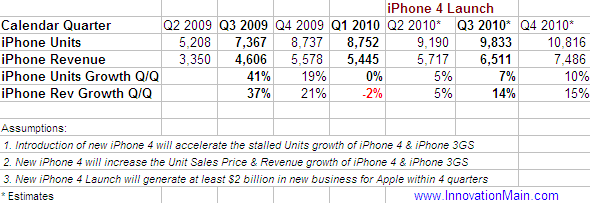
The new iPhone 4.0 will accelerate the stalled iPhone Units & Revenue Growth beginning the current quarter (assuming iPhone 4.0 goes on sale on June 24), and jumping in the subsequent quarters. Importantly, the new iPhone 4.0 will contribute at least $2 billion in new business for Apple during the first 4 quarters of launch. That's another successful innovation from Apple. Would it fend off the onslaught of Google Android devices, and the impressive success of surging HTC, Motorola, LG, Samsung and others remains to be seen...
How does Apple, the #1 innovative company in the world, innovate and create game-changing innovations such as the iPod, iTunes, iPhone, iPad and more? What is Apple's secret recipe for innovation success?
What is Apple's Innovation Strategy? Download these Apple Innovation eBook insights and learn to be like Apple... like Steve Jobs, the innovator and CEO of Apple.
"There's an old Wayne Gretzky quote
that I love. 'I skate to where the puck
is going to be, not where it has been.'
And we've always tried to do that at
Apple. Since the very very beginning.
And we always will." -Steve Jobs
Apple innovates through:
• Creativity and Innovation
• Innovation in Products
• Innovation in Business Model
• Innovation in Customer Experience
• Innovation and Leadership
• Steve Jobs Visionary Leadership
This Apple Innovation Strategy ebook provides insights, strategy, best practices, facts and much more...
Apple has built an Innovation Factory – one that harnesses creativity in its people, stimulating new ideas, and launching successful, profitable new innovations... Apple leverages its diverse culture, innovation processes, partners and networks to seize the new opportunities in the marketplace and grow its business...exponentially…
• Increase revenue more than 400% in 8 years…
• Increase net profit more than 650% in 8 years…
• Increase market cap more than twenty times to over $170 billion and
counting…
The Apple Innovation eBook has been revised in 2011, and includes new insights, Steve Jobs interview, and much more.
Download Apple's Innovation Strategy and learn to innovate, like Apple, today!!
Design Innovation Source: Apple.com
Putting on a Show in the 21st Century
I really like the two theater trends I've noticed in the past decade or two--going to a show often offers an experience that feels much more like the circus or a rock concert.Take a look at the final scene (right and video here) of Lookingglass Theater's production of Hephaestus here in Chicago (now extended for two more weeks to June 20), playing in our esteemed Goodman Theatre. The story of Hephaestus, the Greek god who could forge anything out of metal, is played out in an amazing array of physical and circus performances, swinging from the rafters, flipping from ribbons and navigating the trapeze. Yes, those are seven high wire performers, including veteran members of the Wallenda Family, Ringling Bros. and Cirque du Soleil, way up above the audience (click the pic to see video of it live). I believe the future here is in the merging of narrative and acrobatic acts of wonder, as seen in Hephaestus, illustrating how innovation comes through hybrids--the combining elements in ways not quite seen before.
The other theater trend--the full-band, rock out shows perhaps first popularized by"Rent"--also works in engaging me and has thankfully updated the musical for a post-Beatles world. I'd like to hear what your favorites have been.
